
How a conversation with journalist Dr. Kathryn Miles about covering the sinking of the Bounty reminded me of an unsafe tall ship I’ve worked on
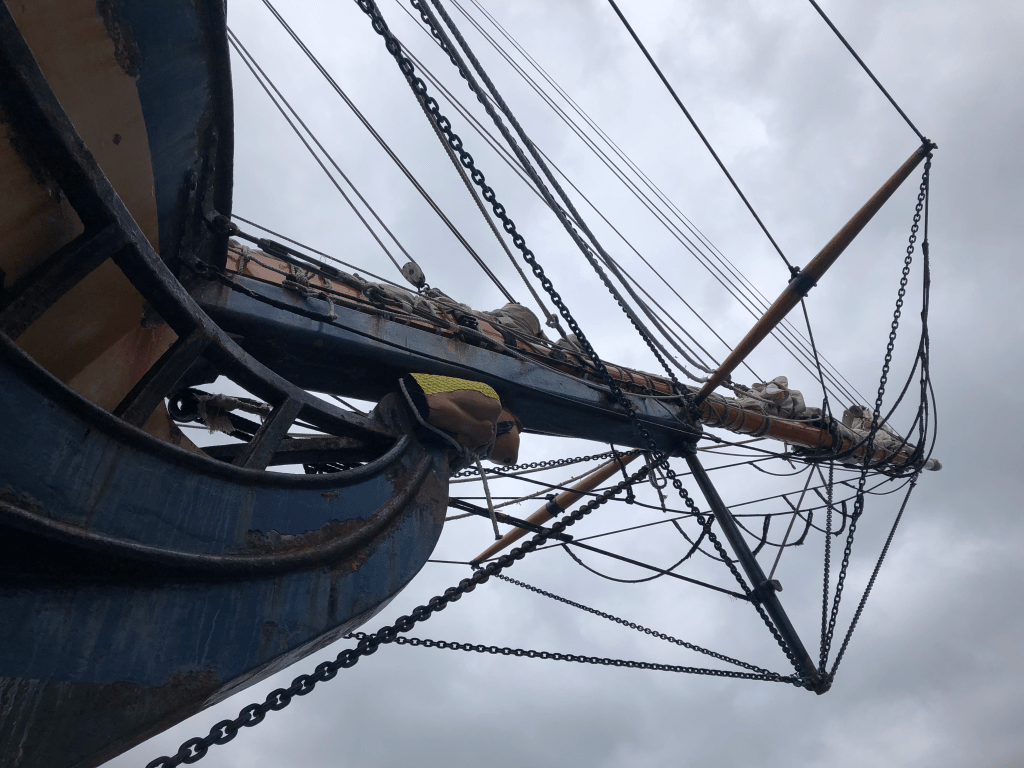
In one of our Nature Writing classes this week, my Western Colorado University MFA cohort had the privilege of talking with Kathryn Miles about her book Trailed: One Woman’s Quest to Solve the Shenandoah Murders. As a female-presenting, queer outdoor professional, I wish it were required reading in every college recreation program.
But the conversation also reminded me of tall ships. Partly because everything does and partly because Miles covered the sinking of the Bounty for Outdoors in 2013. One of my classmates asked Miles about her process for finding and interviewing sources, and she told us how interviewing Captain Robin Walbridge’s widow after the ship sank led her to approach sources—especially the family members of people who have died—differently. Including the families of the victims of the Shenandoah murders.
The Bounty was a full-rigged ship; she had square sails on all three of her masts, and at 409 gross tons, she was nearly twice the size of the original HMS Bounty, a merchant ship the British Navy bought in 1787 and sent to the Pacific on a botanical mission. After a mutiny in 1790, the crew burned the original, and the incident inspired the 1962 Marlon Brando movie Mutiny on the Bounty for which the replica ship was built in 1960.
After the movie, it was not smooth sailing for the Bounty. She ended up as a dockside attraction in St. Petersburg, FL, changed hands three times, and was on the market again when she sank. It’s expensive to maintain tall ships, especially wooden ones, and when previous owners don’t take care of a boat, pricey fixes compound. From 2001 to 2012, the owners only hauled her out of the water for maintenance three times. Many wooden boats have an annual haul out just to keep up with routine upkeep, let alone years of neglect.
The Bounty was in dry dock in Connecticut immediately prior to sinking, but, like many tall ship haul outs, the burden of fixing numerous issues on a shoestring budget in too little time fell squarely on the small crew. Miles reports in the Outdoors article that “deckhands took to calling the ship Bondo Bounty after they were repeatedly told to fix structural problems with hardware-store polyurethane sealant,” which worked about as well as you’d expect. In the fifteen years prior to sinking, the Bounty had several close calls, including rescues involving the Coast Guard in 1998 and 2001 when she began taking on massive amounts of water while transiting.
The boat passed Coast Guard inspections, but only as a dockside attraction, not a passenger vessel; however, there were loopholes that enabled her to take on trainees as temporary crew and even complete a round-trip Atlantic crossing, all officially as a dockside attraction. Before sinking in Fall 2012, the Bounty’s owners requested earlier in the year for the American Bureau of Shipping to reconsider the dockside designation and let the vessel officially take on passengers. The bureau gave them a list of things they would need to fix first, including patching holes in several watertight bulkheads, which the owners did not address.
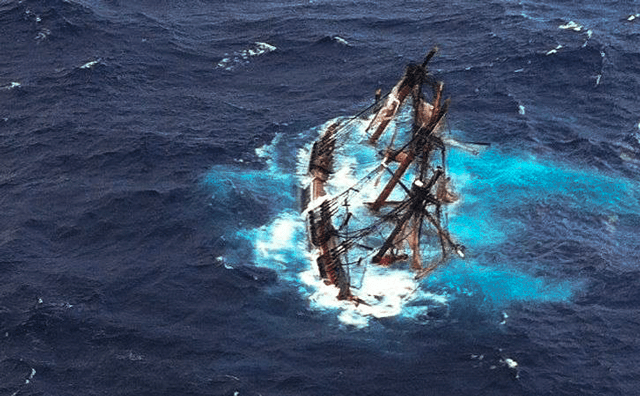
When the Bounty’s haul out in Connecticut ended in October, 2012, Hurricane Sandy was looming off the East Coast. With input from the crew, Walbridge initially decided to take the ship East out to sea and transit back down to St. Petersburg around the words of the storm. But they changed course, attempted to transit through the hurricane, and sank off the coast of North Carolina.
Ultimately, a National Transportation Safety Board investigation determined:
“[…] the probable cause of the sinking of tall ship Bounty was the captain’s reckless decision to sail the vessel into the well-forecasted path of Hurricane Sandy, which subjected the aging vessel and the inexperienced crew to conditions from which the vessel could not recover. Contributing to the sinking was the lack of effective safety oversight by the vessel organization.”
While some of the most experienced tall ship captains in the industry have criticized Walbridge’s decision to transit through Sandy, the crew may not have been as inexperienced as the board suggests. At least for tall ships.
The vast majority of tall ship sailors are severely underpaid—if not volunteering—and have no benefits. We work precarious, short seasonal contracts. It’s a difficult career to make sustainable long term, something the pandemic in 2020 has only exacerbated. Only, before the pandemic, because of how cool working on tall ships is, there was always a surplus of new volunteers and deckhands to replace the attrition. At least now, tall ships are moving towards longer contracts and better pay to retain experienced crew. In 2012, it was par to just replace them.
So the fact the first mate had been onboard for two years is unusual. Plus, the Bounty’s crew had a lot more training than most. In addition to the captain and mate, two other crew members had USCG captains’ licenses, and one was a maritime academy graduate. Four had able bodied seaman (AB) credentials, which require at least 180-360 days of seatime: 180 on sailing vessels for a Sail AB or 360 for the full, general AB deck rating. While six months to a year might not seem like a lot of experience, and the board highlighted that the majority of the crew had less than two years cumulative experience working on a tall ship, many sailors don’t, including myself. The number of licensed crew members on the Bounty when she sank is more than most tall ships have, which might be why there were only two casualties: Walbridge and the ship’s newest crew member, Claudene Christian.
The truth is, lots of tall ships could very easily become the Bounty under the right conditions; many are just as poorly maintained. I worked on one the summer of 2019 that might have been worse.
As not infrequently happened in the 70s and 80s, eccentric millionaire Laurence H. Dorcy Jr. commissioned the steel-hulled, triple-keel hermaphrodite brig/square topsail ketch Hawaiian Chieftain in 1986. She launched in 1988 and, after her maiden voyage to French Polynesia, ended up in California with the company Voyages of ReDiscovery, facilitating history education for 4th and 5th graders with Grays Harbor Historical Seaport’s brig the Lady Washington. In 2004, she changed hands and moved to Cape Cod as a sail training vessel, but when her new owner unexpectedly passed, Grays Harbor purchased her and sailed her back to the West coast where she operated as the Lady Washington’s companion vessel until Aubrey and Matt Wilson purchased her in July 2021.
Only she didn’t sail from 2019-2021. I know because I worked her last haul out in June and July of 2019. I initially signed up as a volunteer deckhand for history education sails and a two-week yard period in Port Townsend, WA, but after failing multiple Coast Guard inspections for holes we found in her hull while manually rust busting with angle grinders (Grays Harbor didn’t want to pay to sandblast Chiefie), the haul out became indefinite. I stayed because they hired me (on a stipend of $800 dollars a month).
Even if the Hawaiian Chieftain had been seaworthy, we didn’t have the crew to sail her; the captain and first mates’ contracts ended at the beginning of the yard period. Our project manager, the bosun, did her best to scrape together what few resources she could to continue maintenance, but by July, we only had four permanent crew, one of whom was the cook. None of us had Coast Guard licenses. A few dedicated volunteers joined us on the weekends, but, like the Bounty, the owners did not hire professional yard workers for maintenance. They just rented the yard space. It was all up to us, and we were under qualified and under-resourced. We were not able to make the necessary repairs.

In July, our contracts ended, and we all chose not to renew them. As a result, Chiefie sat in Port Townsend until Grays Harbor hired a few brand new tall ship sailors to get the leaking vessel to the Tongue’s Point Maritime Academy in Astoria, OR, where they hoped the academy students could fix her for free as a training opportunity. In 2022, when working on the tall ship Atyla in Spain, I met one of the sailors Grays Harbor hired to transit Chiefie to Astoria. She is one of the most qualified tall ship sailors I know, and her story with Grays Harbor is all too common; it was her first ever tall ship job, and they had to hire brand new crew because more experienced sailors wouldn’t do it. Often, the least experienced tall ship sailors work on the most precarious boats because the ships with enough funding for regular maintenance also have the funding to retain experienced crew. It’s harder to get an introductory job on a safe ship.
In Spain, we toasted Chiefie and the fact that my friend survived the transit. Had they encountered inclement weather, Kathryn Miles might have had to write another article for Outdoors.
When the Wilsons purchased the Chieftain in 2021, they hired a professional towing company to bring her back to the yard in Port Townsend, where they began the serious undertaking of refitting her. They have a blog series on their website called “Past and Present” where they’ve shared progress from 2021 to 2024, including some pretty alarming photos of the extent of corrosion on her deck, hull, and compartment soles and walls. In addition to the rust, they report she needed new engines, a whole new electrical system, new tanks, new plumbing, a new galley, a new mainmast, a new jib-boom, a new topmast and “probably other new things we haven’t yet discovered.” Basically, everything needed to be replaced, which might be why the Hawaiian Chieftain is once again up for sale.

While Grays Harbor Historical Seaport reported they sold the Hawaiian Chieftain to be able to invest fully in the Lady Washington’s upkeep, current crew says that’s not happening. I haven’t worked on her in years, but the fabulous instagram account Schooner Bum Memes, which is a staple of the tall ship community, recently posted this:
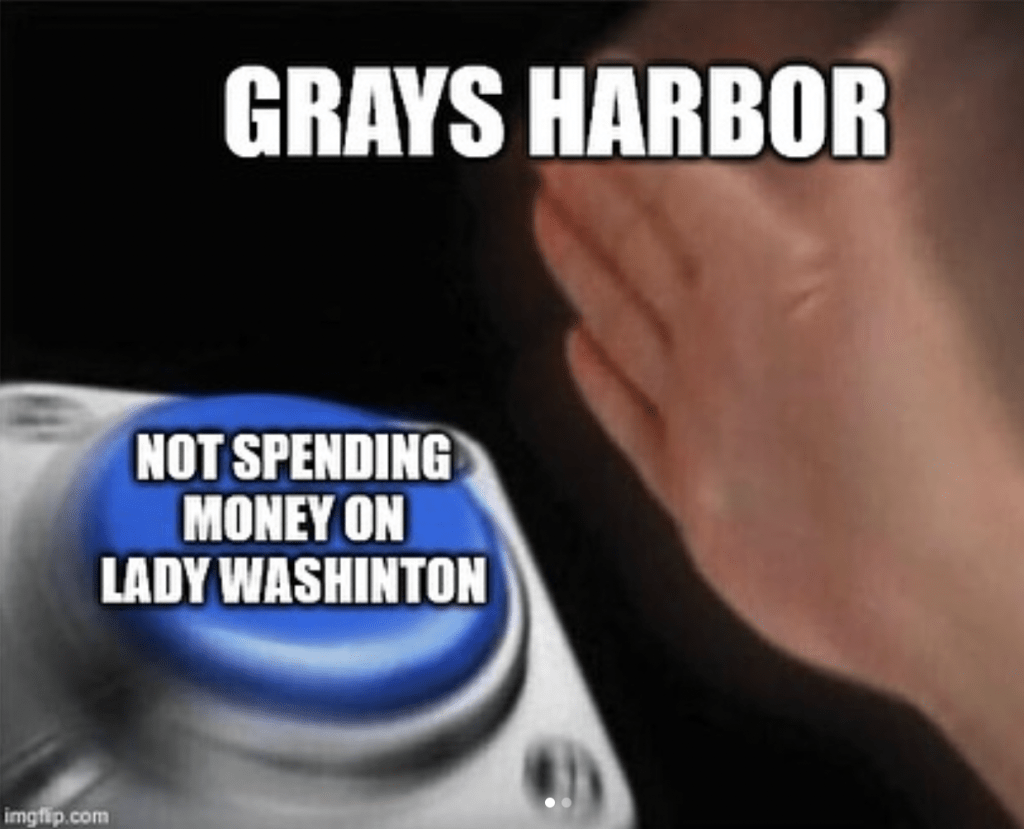
The first comment is from one of their former, long-term permanent captains, “Brother speak it louder for the people in the back.” As a college student, she worked on the Bounty the summer before it sank.
Apparently, the ship is collateral for a seaport property Grays Harbor purchased in Aberdeen, WA that turned out to be a superfund site. I suspect they’re worried if they don’t funnel a significant chunk of the nonprofit’s budget into site cleanup, they’ll lose the Lady, but if they keep neglecting her maintenance, they’re going to lose her anyways, and they’re jeopardizing the crews’ safety in the meantime. Just like the owners of the Bounty.
When I reread Miles’ article about the Bounty, I was struck by her compassion for Walbridge and the crew. Miles is not a tall ship sailor, but she still highlighted the sailors’ passion and dedication for the ship and the disrepair she had fallen into. As someone who has worked on an unsafe tall ship out of love for the boat and its programming, I’m grateful for that grace.
Read more: Working on a Boat Like the Bounty
 Kira Rambles
Leave a comment