I once took an undergrad outdoor education pedagogy course in which a classmate taught a lesson on quantum physics as his final. We had no test; instead, the professor wanted us to blend feedback we’d received on lesson plans and micro-lessons we’d submitted and taught over the semester into one, hour-long class on a subject of our choosing. He said the best way to learn to teach was to do it.
We all studied Recreation and Outdoor Education, and most of us had declared an emphasis in Outdoor Environmental Education emphasis, hence the pedagogy class. That emphasis required some science courses–mostly geology and biology and subjects our professors saw us using as environmental educators. Physics wasn’t on the list.
Even though we had taken science courses, and many of us were likely to teach environmental science after graduation, the lessons we taught for our final mostly revolved around some kind of outdoor-recreation-related skill. We learned about foraging, wilderness medicine, firearm safety for hunting, waxing skis. Most of us were already working as rafting or backpacking or fishing guides in the Summers, and, honestly, we taught lessons we had already given in some capacity to our clients or colleagues.
My classmate who taught quantum physics worked as a mountaineering guide at a pay-to-play guiding company for well-to-do clients on the Western Slope of Colorado, but he didn’t teach knots or trad gear placement. And he blew the lesson out of the water. He presented the information concisely and understandably. He taught at our level without making us feel like he was dumbing the information down. It was incredible.
When we asked him why quantum physics, he told us he chose the topic because he wanted to teach us something we knew as little about as our clients and students might know about the outdoor skills and ecosystems we’d be immersing them in.
“What we’re saying probably sounds like quantum physics to them,” he said.
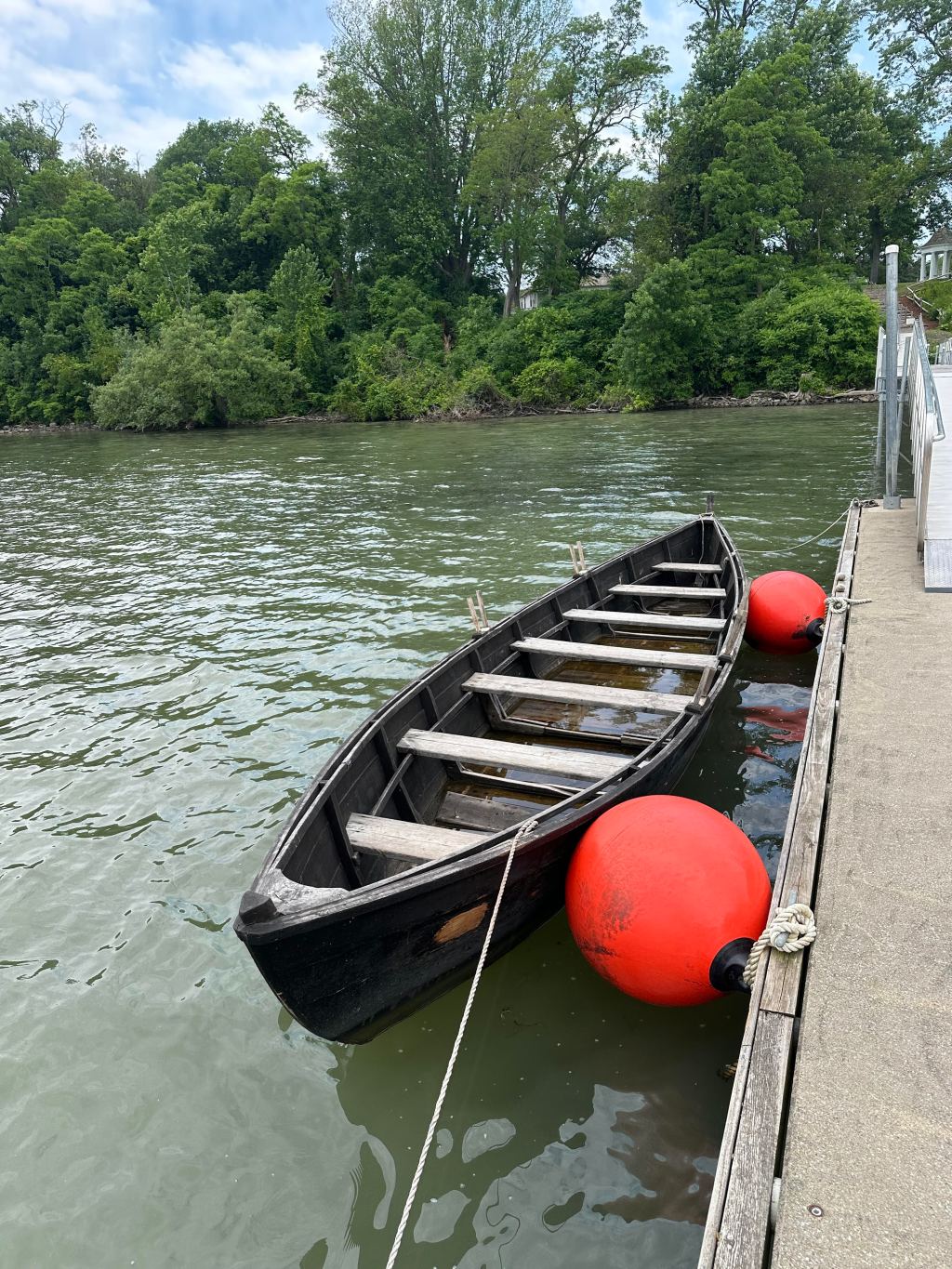
As a maritime trades interpreter at Ticonderoga, I guided multiple groups of homeschool students and parents on excursions rowing a 22-foot, 18th-century-style rowboat (bateau) on lake Champlain this Fall during the fort’s annual Homeschool Day. The excursions were only 20 minutes, and the first one coincided with the start of the maritime history tour on the fort’s 60-foot tour boat, which leaves from the same dock as the bateau.
I felt rushed, and I didn’t want to be behind the tour boat when it left, so I selectively skimmed my usual introduction about the history of bateaux, loaded the rowers and oars, and pushed us off the dock. We were already out on the lake when I realized I had assumed the students and parents knew quantum physics.
“Why would I know how to do this?” A parent who had volunteered to row first was struggling. Our oars, carved from alder and over ten feet long, like to stay parallel to the surface of the water. They have square shafts near the handles that keep them from rotating in the oarlocks, and if one holds the handle around eight inches inside of the boat, keeping the oar on a good balance point in the oarlock to just barely immerse the blade of the oar under the water with each stroke, they don’t feel that heavy. But if one holds the handle too close to the oarlock and lets the blade drop perpendicular to the lake’s surface, rowing feels nearly impossible.
I was steering and not in a convenient place to stop and teach rowing, but I had also created the problem by not demonstrating before we left the dock. Thankfully, we had an on-dock wind that day, so we weren’t drifting anywhere unsafe, but I had forgotten my pedagogy class. I had forgotten quantum physics.
I was on the receiving end of many quantum physics moments my first season working as a historical interpreter, unfamiliar with many skills my seasoned colleagues knew automatically like buttoning and mending historical clothes or putting on 18th century shoes, which I guess is proof it’s easy to forget we once had to learn what we know now.
“Why is that a thing?” I found myself asking frequently, like when I asked if there was a way to better waterproof my leather shoes, so I wouldn’t have to walk around with wet feet all day after the dew permeated by my toes when I had to walk through the grass to get to the boathouse every morning.
“Shoeblack.” One of the shoemakers handed me the 18th century equivalent of shoe polish nonchalantly. It contains beef tallow, and the fat helps repel water. I felt like a kid at bring-your-child-to-work-day at Lockheed Martin or NASA, although it beat the other answer I had received that morning.
“Naw, you just have to wear wool socks and embrace the introductory trench foot!”

 Kira Rambles
Leave a comment