“Do you need a doctor’s note to not work this afternoon?” The ER doc charts my visit–a quick one. I managed to give myself a three-milimeter-deep laceration diagonally into the joint on my left thumb with a handsaw trying to take the end off a fifteen-foot poplar sapling we felled to serve as the sprit for a bateau sail. She scrubbed and glued the wound and made me promise to wear a splint, so I won’t bend it and bust off the glue.
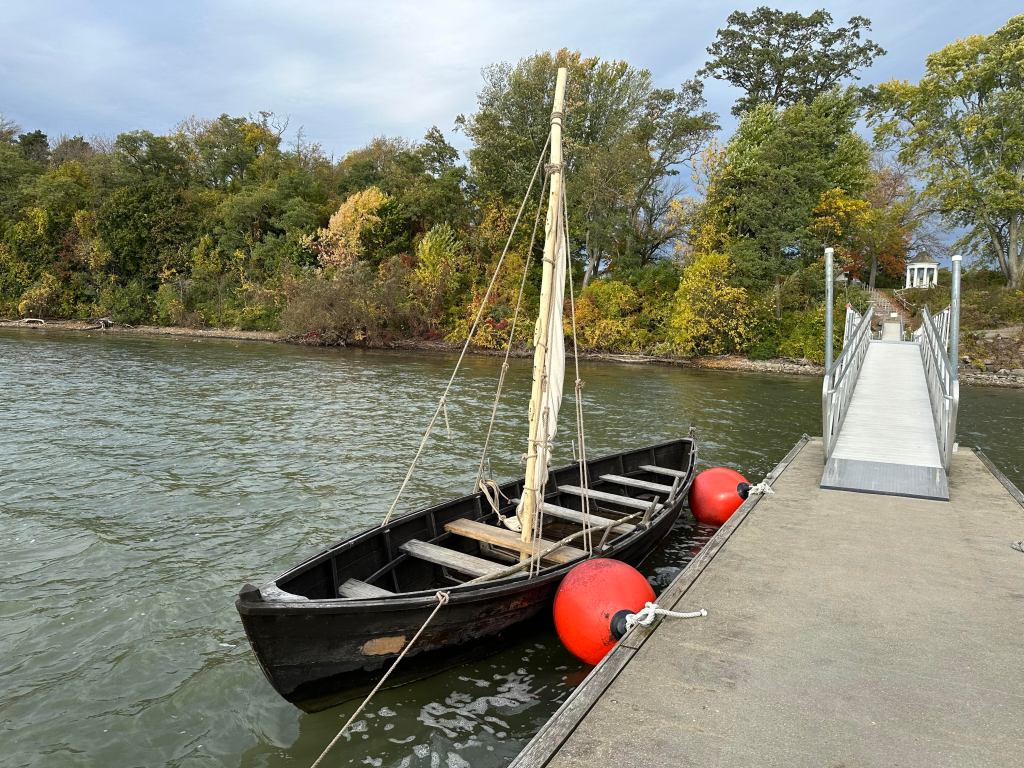
Building bateaus is my job for now. A bateau is a flat bottomed rowboat roughly thirty feet long that stemmed from the French flat-bottomed bateau plat river boat. The French brought the design to North America, where the British and American Colonists figured out it worked well on rivers and lakes here too and just started calling them bateaus. In addition to civilian use, they became the primary way to move troops on Lake Champlain and Lake George during the French and Indian and Revolutionary Wars, which is why we build them at Fort Ticonderoga. They’re rowboats, but we have plenty of instances documented when soldiers got sick of rowing them and rigged sails. One time, some highland Scottish soldiers even held up their greatkilts as bateau sails on Lake George, which probably isn’t as bad as you’re picturing, since they made highland soldiers wear breeches under their kilts in North America.
Bateaus’ flat bottoms are supposed to make them easy to construct. The British navy standardized a 31-foot design in 1776 that’s supposed to be simple enough a carpenter can build it. No boat builder necessary. The problem is that I’m not even a carpenter. None of the maritime interpreters at the fort are. Our boss is a master carpenter, but his job entails a lot more than building boats, so we try to absorb his skills in the few hours we can snag with him a week and make the best of our limited knowledge the rest of the time. We just finished the frame of a new bateau and are currently re-planking one previously built at the fort. Planking is the most technically complex part of the bateau-building process, though, and my boss has been busy, so he gave me a new project for when the planking stalled, and he couldn’t get away to help: rigging a sail in the bateau we already have in the water.
A previous maritime interpreter at the fort stitched a sail that I originally thought was a gaff sail, so I started constructing a mast and two spars, a boom and a gaff, to support the top and bottom of the sail. But when my boss and I started talking about blocks for haulyards, my colleague said that sounded too complicated and mentioned the previous interpreter called the sail a spritsail. Spritsails only have one spar. It runs diagonally from a cleat on the mast to the peak of the sail and eliminates the need for a halyard. You just need a rope to attach the sprit to the mast–called the snotter–and a sheet to control the foot, or bottom corner, of the sail.
When we went to fit the sprit in the bateau, though, we discovered a problem with the sprit dimensions we copied from a copy of a diagram the previous interpreter drew when making the sail that materialized halfway through our rigging project. The length of the sprit he called for would need to be made off to the mast ten feet above the bateau. To be able to make the sprit off to a reachable point from the boat, we’d need a longer sprit. Three feet longer. So my boss and I set off into the woods by the fort with an ax and the old sprit for measurement and cut down a poplar sapling. We vowed we were going to sail that day, so we decided to skip stripping the bark and just cut and tar the ends of the sprit, which is when I cut myself and ended up in the ER.
That afternoon, when I got back from the hospital, and we rigged the new sprit and used it to sail across the lake to Vermont, I was glad I didn’t ask for that doctor’s note. Sure, was rowing the boat a mile back to New York against the wind without the ability to bend my left thum a pain? Absolutely. But sailing a bateau was an unmissable opportunity. Despite the ER visit, it was one of those days that remind me how cool my job is.
The first day like that I remember also involved tromping through the woods looking for a tree. We needed to harvest a branch with an almost 90-degree bend for the bow piece of the new bateau frame, so my boss and I set off into the forest with an axe and a plywood outline of the piece’s silhouette to measure the angle. After fifteen minutes of bushwacking through the upstate undergrowth, we stumbled on a field of ferns straight out of Jurassic Park, four feet high with leaves like the feathers on the well-fed peacocks that roam free-range in zoos, terrorizing children for curly fries. I stood in the middle and just smiled for a minute. I couldn’t believe they were paying me to be there.
Last week, a visitor asked me if my high school self would have believed this is my job now. I said yes, but because I was a huge nerd. I remember watching Master and Commander and dreaming of trekking through Brasil looking for a new mast for the Surprise with Russel Crowe. Ticonderoga isn’t Brasil, but selectively harvesting compass pieces with curves specific to the swooped edges of a boat is pretty close. High school me would have loved this.
I try to remember these moments when I’m overwhelmed with visitors mansplaining woodworking or running between tours and demonstrations and skipping lunch. As I get ready to end the season at Ticonderoga and move onto other seasonal work, they’re what I want to remember.
And I’m not sure our bateau trip was what the ER doc had in mind when she told me to take the afternoon off, but I didn’t bust the glue off my thumb. Mission successful.

 Kira Rambles
Leave a comment