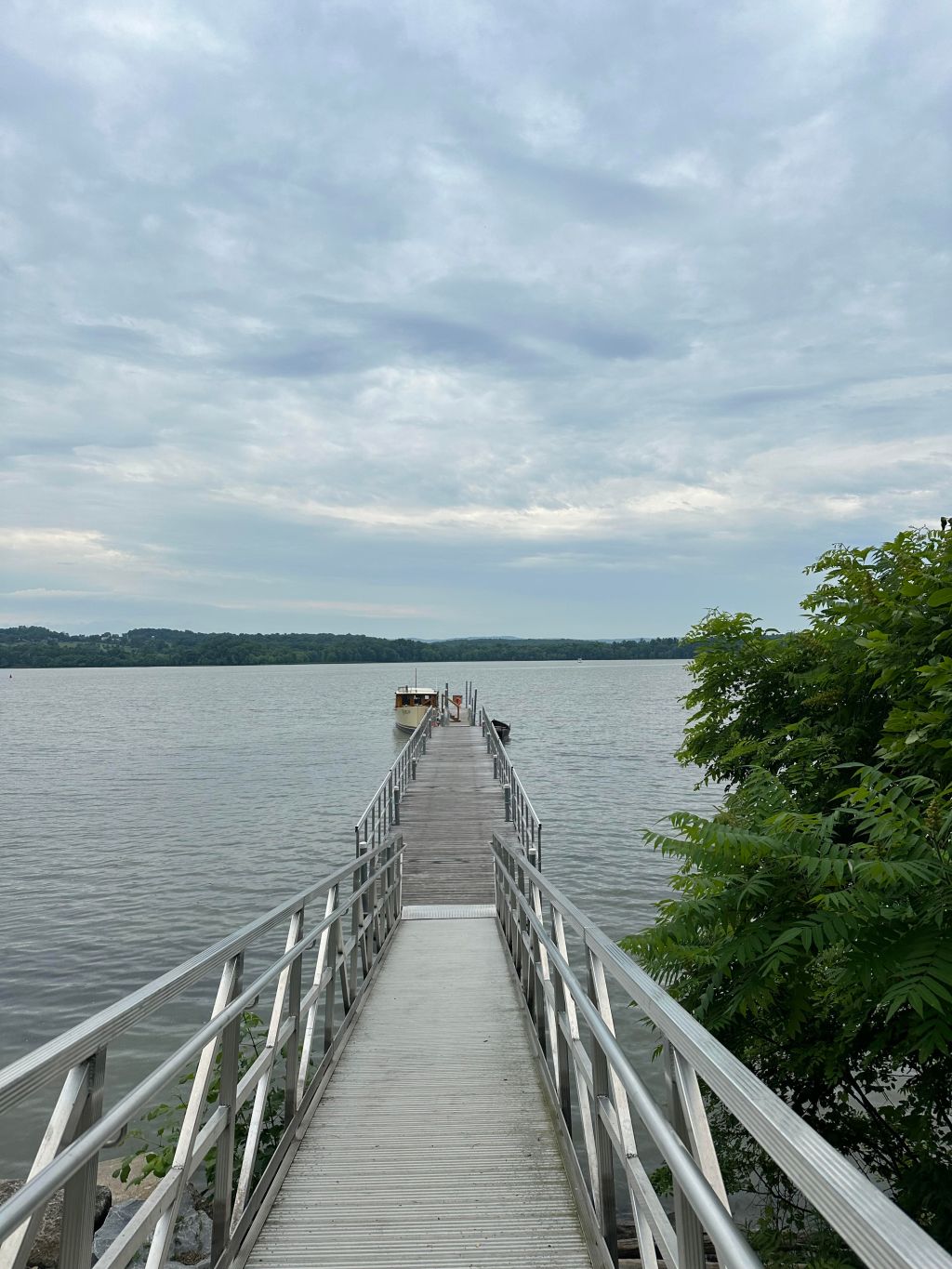
Every day at work, I give at least one 75-minute boat tour about the nautical history of Lake Champlain around Fort Ticonderoga. The fort, where I’m a historic interpreter, owns a 1920s style Thousand Island tour boat, a gorgeous 58-foot long motor vessel with a covered roof held up by inch-long strips of varnished, glazed-duck wood like a wide slatted fence where the non-stop windows seat when closed. When open, they hang subtly above the passengers’ heads, waiting for raindrops or the end of the day. The effect: on sunny days, the boat feels open air and gives visitors a pretty unobstructed view of the shoreline.
But not all the attractions on the tour are on land. Many are preserved underwater, and the sonar on the boat gives guests a glimpse of sunken canal boat wrecks at the bottom of the lake. But we also mention some wrecks we never see. These include the two sunken British ships built at Ticonderoga in 1759 after the Brits took the fort from the French and started bulking up their artillery on Lake Champlain for the end of the French and Indian War. But when the British took Montreal in 1760, it effectively ended the war in North America, and they didn’t need naval force on the lake anymore, so these two ships both fell into disrepair and sank just off the shipyard where they were built. One, the 115-ton schooner Boscawen, is still there. But the second, the 155-ton brig Duke of Cumberland, decayed after the fort’s admin hauled it on the grass to show visitors in the early 20th century.
The tour boat has a bar in the back, and, as deckhand, first mate, tour guide, and bartender, I spent a lot of time back there. The bar was where, this week, I met a kid old that knows more about history than any of the fort’s interpreters. I was at the bar after pointing out the site of the wreck of the Boscawen and explaining the history of the Duke of Cumberland when his dad bought him a soda. Maybe nine years old and wearing a fir green page boy hat that matched his forest flannel and puffy vest, he saddled up to the bar and asked a question I could not answer.
“Wasn’t the Duke of Cumberland a British general at the Battle of Culloden?”
The Battle of Culloden is an infamous 1746 battle in Scotland by Inverness during one of the Jacobite Rebellions, where, I have now learned, the Duke of Cumberland was the British commander that squashed the Scottish forces fighting to install a Stuart king in Britain.
“Um… well… I’m not positive, but that would make a ton of sense, since the British liked to name naval ships after famous guys, like military commanders!” I tried to force my surprised eyebrows down and resist the urge to hug him. He took his soda and sat down.
“He really likes history.” His dad laughed when I made a face like the happy, eye-welling awwwww emoji and tried to articulate that it’s great to meet the future generation of history nerds. I also fought the urge to tell them how I lived in Scotland and think Scottish military history is fascinating and informs so much of the history at the fort, where many Scottish soldiers fought in the 18th century in the French and Indian and Revolutionary wars. Instead, I gave the kid a high five when his family disembarked the boat and sent him to geek out with the shoemakers about Scottish military history, and I shot a text to my colleagues that I just met our future boss.

 Kira Rambles
Leave a comment