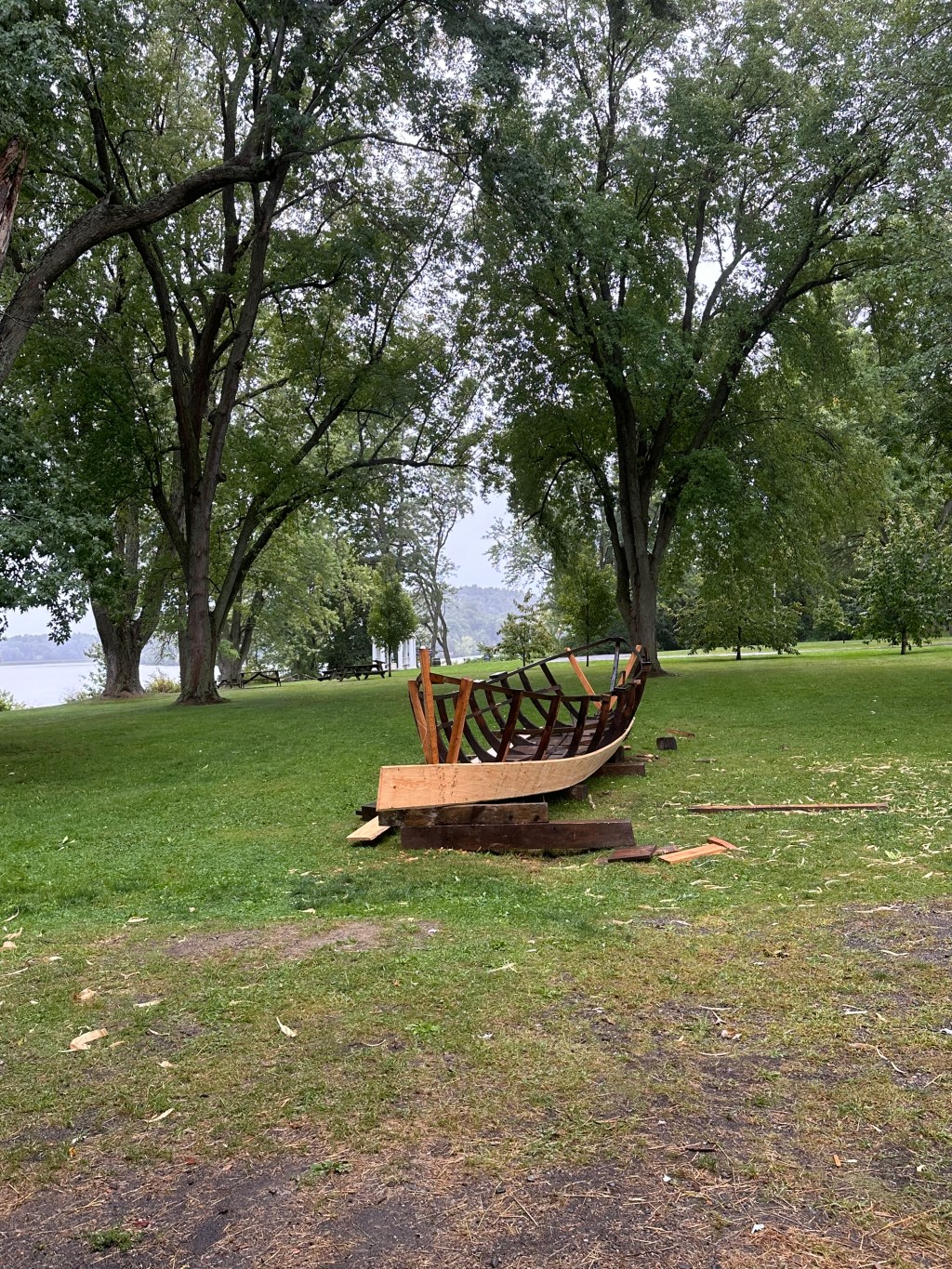
Nothing activates mansplaining like using a block plane in public.
As a maritime trades interpreter at Fort Ticonderoga, I’ve been using an antique block plane to smooth green pine planks and make them more hydrodynamic when we bend them around the frame of the bateaux we’re constructing. A bateau (bateau plat in French) is a historic flat-bottomed rowboat the French brought to North America, and the British and colonists adopted. They became the primary method for moving armies along waterways in upstate New York in the 18th century, hence why we make them at the fort. We have a British Navy plan from 1776 for a standardized 31-foot bateau a local shipwright adapted for our very basic level of boatbuilding expertise, and we’re using it to build one bateau and replank another. That process necessitates a lot of planing.
Wood Magazine calls block planes “often the first hand tool many woodworkers learn to use.” That was not true for me. The first hand tool I ever touched was a bit and brace my grandpa taught me to use building a stand for my parents’ washing machine when I was little. The first hand tool I used at the fort was a hatchet, to hew the bateaux’ ribs, and my favorite hand tool is a maul (a big wooden sledge hammer) we use to split wood. My least favorite, hands down, is the block plane.
Part of the problem is our block planes are beat up. We buy many of our tools from antique shops, and their previous owners often abused them even before we subject them to hard use at the fort. Another problem is that I’m still learning how to set the blade. Too deep, and it tears up the plank. Too shallow, and it does nothing.
But what I hate most about block planes is that every visitor at the fort has thoughts about them.
Don’t get me wrong; visitors can teach historical interpreters a lot. In June, I met students from a PhD program in marine archeology working with the Smithsonian to restore a 1776 wooden gondola preserved in Washington, and our education coordinator learned to make soap from a supremely kind southern woman who noticed her struggling with the process when she worked in Charleston.
Our coordinator once told me public history is learning how to do something for the first time and then interpreting it for visitors twenty minutes later, and that’s exactly what happened to her; she had watched a few YouTube videos on soap making and was doing her best to replicate them when a woman approached her and told her about learning to make soap as a little girl in South Carolina.
When our coordinator confessed it was her first time, the woman nodded, and said, “I know, Sugar. I’ve got all day. Can I sit with you?”
And she did. She spent all day with her, sharing generational knowledge and stories.
But block planes don’t activate that kind of knowledge sharing. Instead, (mostly male) visitors revel in telling us we’re messing up without offering any kind of practical advice or help. And while I know most mean well, after a week of hearing the same comments every day, every hour, I am on the verge of printing volunteer applications and silently handing a packet to every person who tells me I’m using the plane wrong. I know when the blade catches, I need to readjust it. I know I need to go with the grain. I am learning experientially, so I am adjusting, tearing up the grain, swearing, readjusting, and getting, slowly, better. Very slowly.
I would love someone to properly teach me how to use a block plane. I know time is an investment. Plus, public history is extremely place-based, and many local visitors still have skills people have used to survive in these very places for centuries. I would never decline a visitor wanting to invest their time in passing on a skill, but there’s a difference between investing and demeaning.
Sitting with someone is an investment. Making an offhand comment is not.


 Kira Rambles
Leave a comment