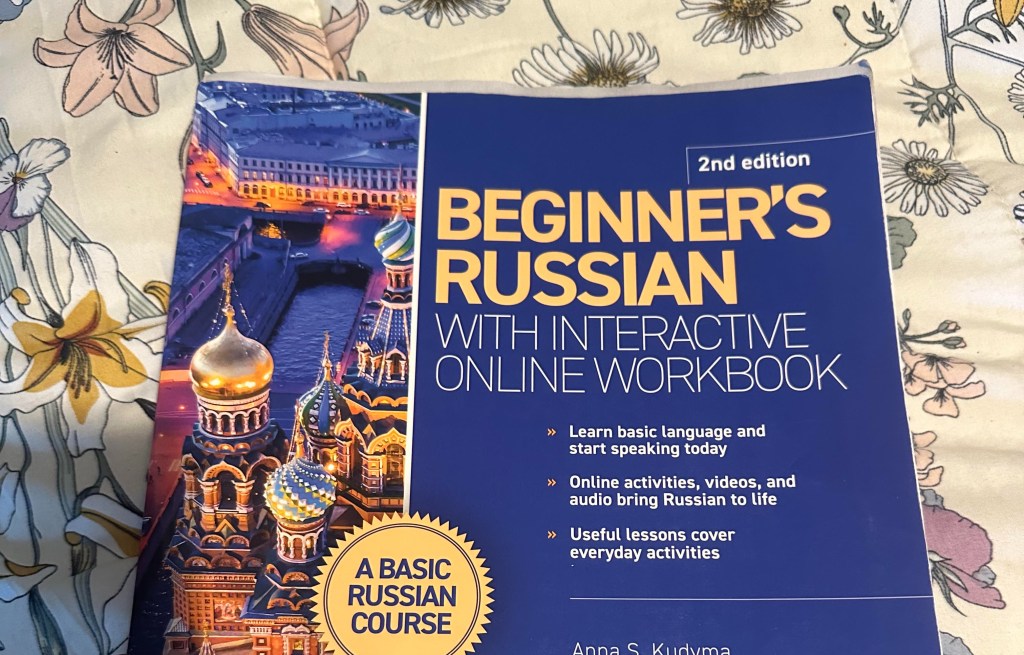
I just finished a State Department virtual critical language program. It involved two hours of online Russian immersion Monday through Friday from ten to noon all summer, and while I work nine to five Wednesday through Sunday, my boss generously let me take long lunches for eight weeks to complete the course; graduates get non-compete status for federal jobs like the parks service, and, having worked in public history for over a decade, he understands wanting employment with benefits.
I work at a living history site, where I portray a sailor from the 1770s, so, Wednesday through Friday, after I set up the tour boat from nine to ten, I ran to the Wifi-equipped office and joined my Russian class wearing an 18th century waistcoat and kerchief.
Fort Ticonderoga opens to the public May through October, and every season sees a combination of new and returning artificers and interpreters making everything from shoes to boats with 18th century techniques and telling visitors about the process. I was one of the few new hires this summer, and, unlike most of my colleagues, I do not have a reenacting or public history background. I studied outdoor education, and, even though my current job description says maritime trades interpreter, I substituted a wilderness medicine course for the one interpretation class required for my degree.
What I did get out of my degree, though, was an understanding of the stages of group dynamics. When you bring a group of people together, it’s likely they will undergo the five stages of the Tuckman Model. Also known as forming, storming, norming, performing, and adjourning, the model is a way to quantify a naturally-occurring progression.
When people first meet, it takes time for them to get to know each other (forming), and they will experience conflict as they hash out roles and rules for their group (storming). Once the team establishes those roles and rules (norming), they enable it to operate efficiently (performing), but the team may regress into conflict when its members know a big change is coming, like the end of a program or a business going under (adjourning). These stages play out in new groups, but they can also restart or regress when you add or subtract group members from an existing team.
I’ve worked seasonally as a tall ship deckhand, farmhand, and backpacking guide. Different seasonal jobs offer lots of different colleagues and teams, and I’ve seen the Tuckman Model play out in a lot of iterations. I thought I was familiar with the stages of group development, but I underestimated the effect of sporadically speaking terrible Russian for two hours in the office and then disappearing back to the part of the fort’s property where we build boats with no explanation. I underestimated how hard it is to get through norming when the graduate fellow and the social media expert in the office either think you’re a spy or have to answer questions like why a historic fort and museum needs a Russian interpreter, and why didn’t they hire a better one?
I have often viewed the Tuckman Model as something that occurs around me when I start new seasonal work. I mistook a naturally-occurring process for a passive one. The truth is that teams have a lot of power over the progression: adjourning goes best when you have compassion for the stress of change; performing when you appreciate and support your group; norming when you name the values that inform the group’s norms; storming when you approach the stage armed with reflective listening; and forming when you’re open and proactively communicate with your new groupmates (it turns out it helps to tell your colleagues you have a remote class).
I also didn’t tell my classmates in the Russian program why I was wearing a waistcoat until week two. In my defense, we didn’t have the vocabulary to explain at first, but, along with keeping people at the fort in the loop, that’s what I’d do differently this summer: look it up sooner.

 Kira Rambles
Leave a comment